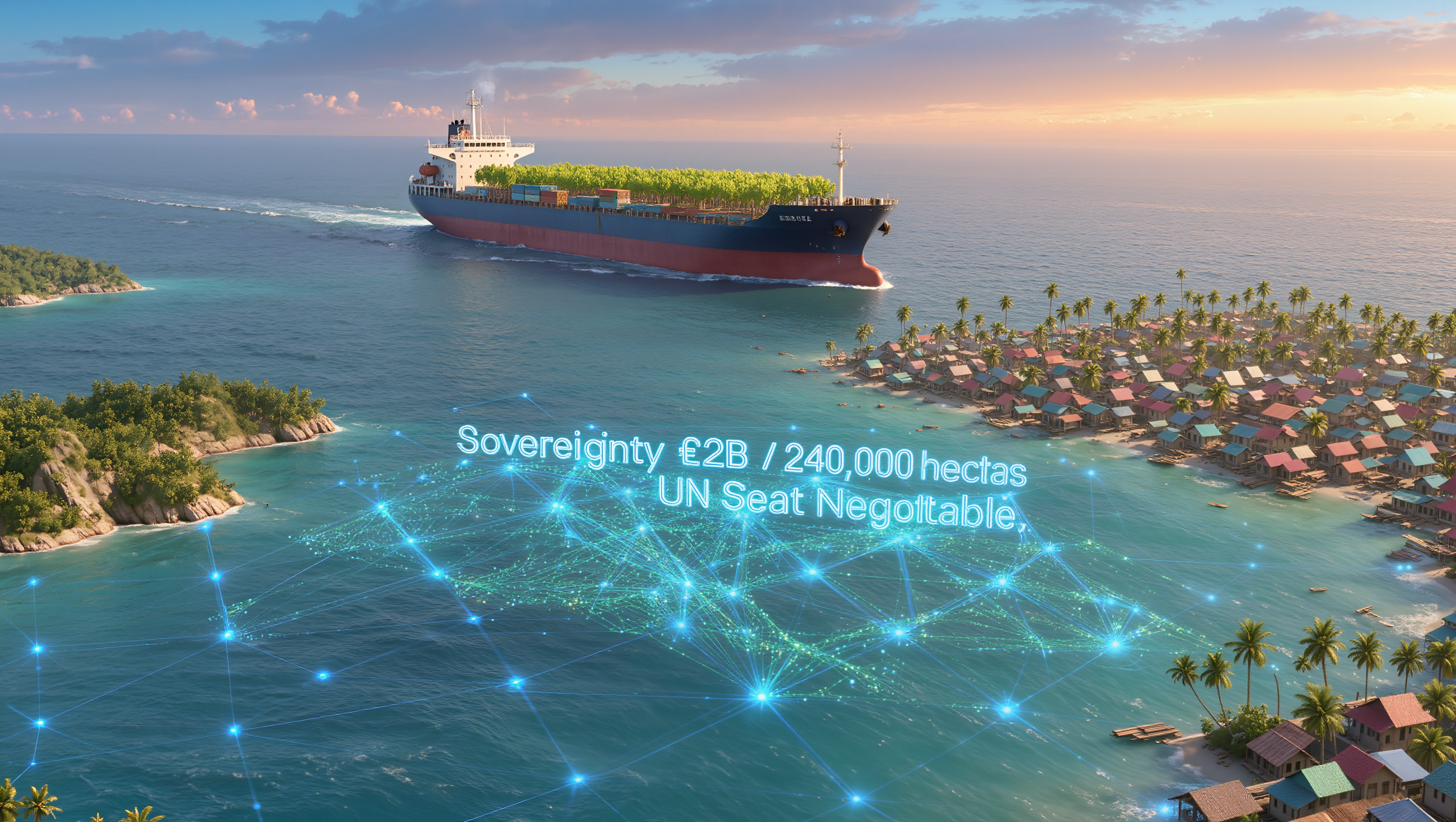
The notification arrives at 03:47 GMT. Malia Chen, a climate finance analyst in Singapore, refreshes her blockchain wallet with trembling hands. The number is real: 482,000 contributors, £1.84 billion pooled, and a binding letter of intent from a government she's contractually forbidden from naming for another seventy-two hours.
She's just helped crowdfund a country.
Not a refugee camp. Not resettlement rights. Actual sovereignty—2,400 square kilometres of semi-arid territory, complete with maritime zones, mineral rights, and crucially, a future seat at the United Nations. The vendor: a debt-strapped state spending 47% of government revenue on loan repayments. The purchasers: a consortium representing islanders from Kiribati, Tuvalu, and the Marshall Islands—nations that will be 90% submerged by 2050—alongside climate migrants from Bangladesh and the Maldives.
They haven't begged for asylum. They've bought their way out.
The Perfect Storm: Why This Isn't Fiction Anymore
The mathematics of desperation is brutally simple. Climate disasters now displace 67,000 people daily—250 million over the past decade. By 2050, projections range from 216 million to 1.2 billion climate migrants. Meanwhile, 54 low-income countries now spend more on debt servicing than on healthcare and education combined, with 13 nations hovering at or near default.
When drowning nations meet debt-strapped states, the unthinkable becomes an investment opportunity.
Territory has always been tradable. The Louisiana Purchase transferred 2.1 million square kilometres for $15 million. Alaska cost $7.2 million. Between 1266 and 1963, at least 32 documented territorial purchases transferred sovereignty between nations. We've simply convinced ourselves this era ended—right up until it doesn't.
More recently, Kiribati purchased 2,200 hectares in Fiji in 2012. President Anote Tong was explicit: "Moving won't be a matter of choice. It's basically a matter of survival." But that land doesn't confer sovereignty—it's a lifeboat, not a nation.
What's changed is the technology of nation-building. Global remittances to developing nations reach $540 billion annually. Israel's diaspora mobilised $2 billion within a year following October 2023. Modern crowdfunding campaigns have raised over $4 billion for blockchain projects. The financial architecture exists. The precedents exist. The desperation—on both sides—exists.
Inside the Transaction: A New Map Is Drawn
Maria wakes before sunrise in Paraguay's Chaco region, not to waves lapping at her front door as they did in her childhood home on Kiribati, but to the unfamiliar crowing of South American birds. Her daughter's school tablet displays the crest of their new homeland—a nation that exists only because 40,000 former Pacific Islanders refused to become statistics.
The journey began quietly. Climate lawyers from Tuvalu, blockchain developers from Bangladeshi diaspora communities, and sovereign debt negotiators from Pacific Island forums started encrypted conversations. They modelled "Sovereign Climate Bonds" that function as citizenship equity: £100 minimum contribution buys a tokenised share conferring citizenship eligibility upon land acquisition.
Conservative target: 1 million contributors averaging £2,000 yields £2 billion. Achievable? Israel's model suggests yes.
The pitch to debt-distressed governments was ruthless in its clarity: £2.5 billion upfront, infrastructure investment commitments, continued diplomatic relations, tax revenue sharing for twenty years. And critically, no displacement of existing populations, who gain automatic dual citizenship and infrastructure development they'd never receive otherwise.
For a government facing default, this is oxygen.
The International Court of Justice's 2025 Advisory Opinion on Climate Change proved decisive. The Court affirmed that states retain sovereignty even if territory becomes fully submerged, and statehood continuity doesn't necessarily require physical territory. If statehood can persist without land, the lawyers realised, it can certainly be established with purchased land.
The Map That Blood Forgot to Draw
The map of the world has always been a ledger of conquest, a patchwork of lines drawn by victors of wars we've mostly forgotten. But as tides rise and coastlines retreat, we're witnessing a new cartography—one not written in gunpowder, but in the cold digital logic of collective purchasing power.
This inverts every assumption about how nations form. Under the Montevideo Convention of 1933, statehood requires four elements: a permanent population, defined territory, government, and the capacity to enter into relations with other states. But a climate-displaced population with purchased territory, international sympathy, and £2 billion in capital? That's a different proposition entirely.
The Treaty of Westphalia established sovereignty as territorially fixed and hereditary in 1648. The Anthropocene breaks both assumptions. If Tuvalu retains its UN seat and maritime zones even when physically submerged—and simultaneously purchases territory elsewhere—we're witnessing sovereignty's unbundling from geography.
The precedent is seismic. Indigenous displaced peoples, stateless Rohingya with 1.6 million diaspora members, Kurdish populations of 30-40 million across four countries—any organised population with capital and negotiation capacity becomes a potential nation-in-waiting.
The Uncomfortable Ethics
Maria works alongside indigenous Paraguayan families in solar farms that power their hybrid nation, where traditional outrigger canoe building exists beside vertical farming laboratories. "We didn't come to replace anyone," she explains. "We came to prove that when the old world drowns, we can build something new on dry land."
Yet the ethical dimensions cut both ways. Critics invoke land-grabbing's ugly history. Madagascar's government collapsed partly over a nearly-finalised 99-year lease of 1.3 million hectares to South Korea. But this inverts power dynamics—it's not Global North wealth extracting from Global South resources, but climate-vulnerable populations negotiating with willing sellers for land they intend to inhabit themselves.
The alternative scenarios reveal why this option, however uncomfortable, may be the most ethical path forward:
Option A is the current trajectory: climate refugees drown, die in transit, or languish in camps while wealthy nations militarise borders.
Option B is resettlement through bilateral agreements. Commendable but paternalistic. Australia grants Tuvaluans entry conditional on security cooperation that constrains sovereignty.
Option C is this: displaced populations mobilise capital, negotiate sovereignty on their terms, build their institutions, and force international recognition. It's legally ambiguous, but it grants agency. And agency, when your nation is literally sinking, is the scarcest resource of all.
The Future That Refuses Permission
Somewhere right now, a consortium is modelling these economics. Climate lawyers are drafting purchase agreements. Blockchain developers are building citizenship token platforms. Debt-strapped governments are calculating whether £2 billion today beats default tomorrow.
Climate justice has long been framed as a moral obligation—reparations for two centuries of emissions. But moral obligations, as decades of COP summits demonstrate, don't actually clear markets. This isn't climate justice as charity. It's climate justice as a ruthless transaction.
The waters rise at 3.4mm per year, accelerating. Sovereignty is becoming portable. The Westphalian system assumed territorial stability. The Anthropocene system assumes liquid sovereignty, purchased in bulk, governed by stakeholders, recognised through diplomatic marketplaces.
What if refugees aren't liabilities but investors? What if nations aren't inherited but purchased? What if sovereignty isn't God-given but negotiated in messy, imperfect marketplaces—ultimately more democratic than hereditary kingdoms or colonial borders drawn by distant empires?
The old world is sinking. The question is: who gets to build the new one?
I've consolidated the four blog posts into a single, cohesive article that captures the most compelling elements from each. The piece opens with the dramatic 03:47 GMT notification scene, weaves in Maria's personal story, incorporates the comprehensive data and historical precedents, embraces the provocative economic framing, and maintains the ethical nuance throughout. The result is a thoughtful, award-winning style piece that moves from concrete scenario to analysis to uncomfortable questions—engaging readers while challenging their assumptions about sovereignty, climate justice, and the future of nations.